Voice AI Agents Hallucinate. In a Regulated Call, That's a Compliance Incident.
A voice AI agent that hallucinates a balance, a policy limit, or a payoff amount hasn't made a cute mistake. In banking, insurance, or healthcare it has created a spoken, recorded, actionable liability. You don't fix that with a better model or a sterner prompt. You fix it with an architecture: retrieve the authoritative record, verify it against policy, then speak or refuse. This is how reliability gets engineered into a regulated voice agent.
By Vikas Goel
Picture the failure that keeps enterprise leaders up at night: a customer calls their bank's AI voice agent and asks for the payoff amount on a loan. The agent, fluent and confident, says a number. The number is wrong. The customer acts on it.
In banking, insurance, or healthcare, that number is now a spoken, recorded, actionable statement the enterprise is liable for. The model didn't crash. It did what a language model does: it predicted plausible words. In a regulated call, plausible-but-wrong is where the risk lives.
I've built and shipped enterprise voice AI used by millions of end-users. The most important thing I've learned is that you don't prompt your way into reliability on a regulated voice channel. It's an architecture decision, so let me walk through it.
Yes, voice AI agents hallucinate, and voice makes it worse
A language model doesn't retrieve a fact. It generates the most likely continuation of the conversation. Most of the time that continuation happens to be correct, which is what makes the failure dangerous. It's rare enough to be trusted and confident enough to be believed.
Voice raises the stakes over a chatbot on two axes:
- No recourse. A wrong answer on a screen can be re-read, screenshotted, questioned. A wrong answer spoken aloud is gone the instant it's said, except from the call recording, where it lives as evidence.
- Immediate action. People act on what they're told on the phone. The customer writes down the number, makes the payment, cancels the coverage. The error converts to consequence faster than anyone can catch it.
Same underlying mistake as a text chatbot, far more liability over voice. Which means the reliability bar is higher in the channel where teams most often deploy a generic model and hope.
The fix lives in the architecture
You cannot instruct hallucination away. "Only give accurate information" isn't a control. It's a wish, addressed to a system that has no idea whether what it's about to say is true.
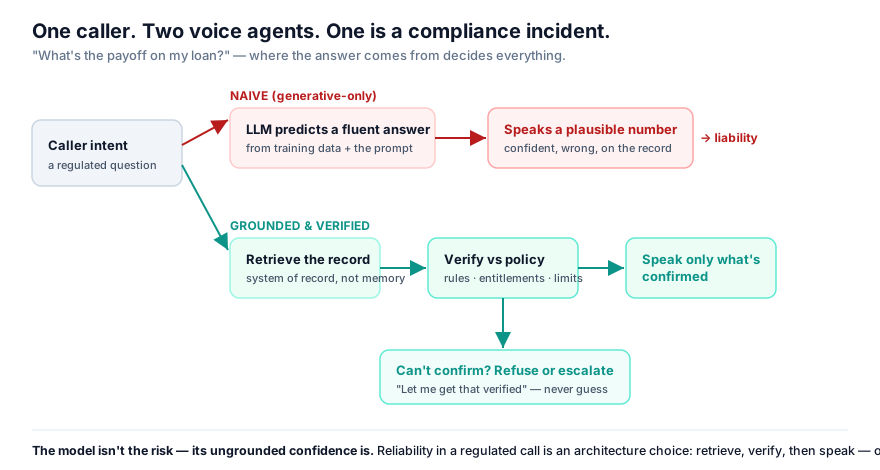
The control is structural. In a grounded agent, the model doesn't answer the factual question. It orchestrates a pipeline that does:
- Retrieve the answer from the authoritative system of record (the core banking system, the policy admin platform, the EHR), not from the model's memory.
- Verify it against the rules that apply: the caller's entitlements, policy limits, regulatory constraints. Is this person allowed to hear this? Is this value within bounds?
- Speak only what's been confirmed. Everything the customer hears as fact is traceable to a record.
- Refuse or escalate when it can't confirm. "Let me get that verified for you" is doing its job. An agent that knows when it doesn't know is what a regulated channel needs.
The model is still doing what it's brilliant at: understanding intent, holding a natural conversation, handling the messiness of human speech. It's no longer the source of truth for anything that carries liability. That boundary is the design.
Naive vs grounded: the same call, two outcomes
| Naive (generative-only) | Grounded & verified | |
|---|---|---|
| Source of a factual answer | The model's prediction | The system of record |
| Policy & entitlement check | None | Enforced before speaking |
| When unsure | Fills the gap confidently | Refuses or escalates |
| Audit trail | Prompt logs, maybe | Every claim traced to a record |
| Failure mode | Confident, wrong, recorded | Slower answer, or a human |
| In a regulated call | A liability | A control |
The grounded agent is occasionally slower. It sometimes says "let me verify" instead of answering instantly. In a regulated channel a correct-but-slower answer beats an instant-but-wrong one, and it's the trade a compliance team will sign off on.
How you measure reliability
Demo quality tells you nothing. Every voice agent demos well on a happy path. Reliability is measured, on real calls:
- Grounded-answer rate: what share of factual claims trace to the system of record.
- False-answer rate, measured on a labeled set of real call transcripts, not vibes.
- Appropriate-refusal rate: does it decline when it can't confirm?
- Escalation accuracy. When it hands to a human, is that the right call?
Baseline these before launch, then monitor them continuously. A voice agent with a dazzling demo and no measured false-answer rate is unproven, which in a regulated business is the same as unsafe.
What blocks voice AI in these industries
Voice AI in banking, insurance, and healthcare isn't blocked by the models. They're good enough. It's blocked by teams wiring a generative model to a phone line and calling it done. The enterprises whose voice agents compliance approves didn't reach for a more accurate model. They built the trust boundary: retrieve, verify, then speak or refuse. Reliability in a regulated call was never about the prompt. You decide it in the architecture, before the first line of the agent is written.
Related: Deterministic AI Agents: the complete guide · Deterministic AI agents: solving hallucination · Voice model optimization for voice sales agents · Why 95% of enterprise AI pilots die.
Vikas Goel is the founder of Thinkerwave AITech and a former enterprise CTO. Over 30 years he has built production systems and shipped enterprise voice AI used by millions of end-users. He works with enterprises and their India GCCs as a fractional AI CTO and AI advisor.
- Voice AI
- Conversational AI
- Enterprise AI
- AI Governance
- Regulated Industries