Guide · Deterministic AI Agents
Deterministic AI Agents: Definition, Architecture, and When to Use Them
A deterministic AI agent is an agent whose behavior stays bounded, grounded, and auditable even though the language model inside it is probabilistic. It gets there by architecture, not by prompting. This page is the canonical guide: what the term means, the four-gate pattern that delivers it, the decision rule for when you need it, and how to measure whether you actually have it.
By Vikas Goel · Founder, Thinkerwave AITech · Updated 16 September 2026
What "deterministic" means for an agent
When people ask for a deterministic AI agent, they almost never mean the same tokens on every run. They mean trustworthy: it won't confidently invent a fact, it behaves predictably against known rules, it's honest about what it doesn't know, and you can reconstruct why it did what it did. That is the definition worth chasing.
The determinism that matters lives in three properties. Bounded: the agent can only take actions that pass fixed checks. Grounded: every fact it asserts traces to a source of record, not to generation. Explainable: the full trail of attempts, discards, and sources is kept, so a decision can be audited afterward. Bitwise reproducibility is neither necessary nor sufficient for any of those.
Agents hallucinate, and a bigger model makes it worse
A hallucination isn't the model breaking. It's the model doing exactly what it was trained to do: produce a fluent, plausible continuation. It was rewarded for sounding right and never for noticing when it wasn't. On an easy problem the obvious framing is usually correct, so this works. On a hard, contested problem the agent picks one framing silently and optimizes inside it, then hands you a wrong answer that sounds identical to a right one.
The reflex is to reach for a more capable model. It backfires. A smarter model doesn't hallucinate less; it hallucinates more fluently, which makes the error more persuasive and harder to catch. You've improved the prose without touching the thing that produced the mistake. I go deeper on this failure mode in how to beat hallucination on the problems that matter.
The deterministic gatekeeper architecture
You can't instruct hallucination away. A prompt that says "be careful" is a wish, not a control. The control is structural: a deterministic enforcement layer that sits in the execution path, between the reasoning model and any consequential action. The model still reasons, plans, and talks. It just no longer gets to act unchecked. Every proposed answer or tool call has to pass four gates before it becomes real.
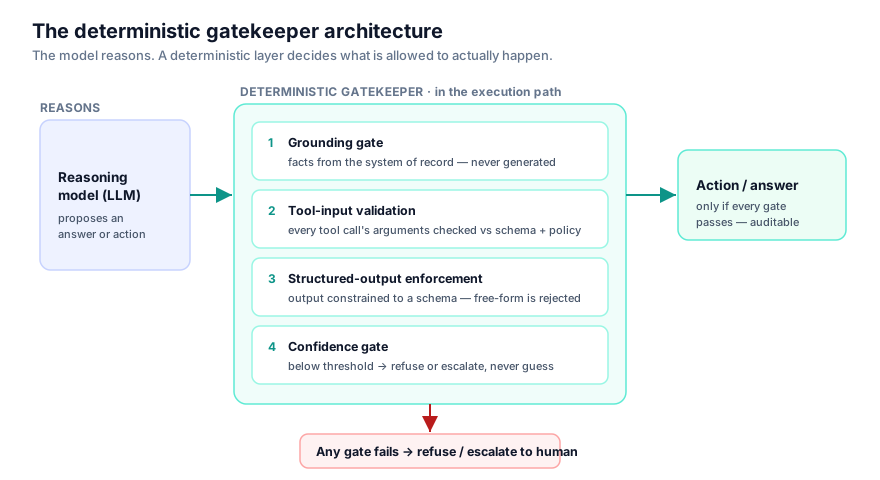
- Grounding gate. Any fact the agent asserts must come from a system of record. If it can't be sourced, it can't be stated.
- Tool-input validation. Every tool call's arguments are checked against a schema and a policy before execution. A malformed or out-of-bounds call never runs.
- Structured-output enforcement. The model's output is constrained to a defined schema. Free-form text where a structured decision is required gets rejected, not parsed hopefully.
- Confidence-gated escalation. Actions below a confidence or verification threshold are refused or handed to a human rather than executed on a guess.
The critical word is deterministic: these gates are code, not model behavior. They do the same thing on every run regardless of how the model performed that time. That is what makes the agent's behavior bounded and predictable while the model at its core stays probabilistic. The determinism lives in the enforcement layer, not in the reasoning.
Deterministic vs probabilistic agents
| Probabilistic agent | Deterministic agent | |
|---|---|---|
| Source of a fact | The model's prediction | A system of record |
| Before a tool runs | Nothing checks the arguments | Schema and policy validation |
| When unsure | Fills the gap confidently | Refuses or escalates |
| Failure mode | Fluent, confident, wrong | Fails closed, with a trail |
| Audit | Prompt logs, maybe | Every claim traced to a source |
| Best for | Low-stakes, easily checked tasks | Decisions where being wrong is expensive |
When an agent should be deterministic
The decision rule is simple: make an agent deterministic when the cost of a confident wrong action exceeds the cost of a slower or refused one. Drafting an email? Let the model run. Moving money, changing a medical record, extending credit, telling a customer about their coverage, answering a regulated question on a recorded call? The gatekeeper isn't optional. It's the difference between a demo and something you can put in production.
Voice is where this bites hardest. A wrong number spoken on a recorded call in banking or insurance isn't a bug; it's a liability the customer can act on immediately. I lay out that specific case in why a voice-agent hallucination in a regulated call is a compliance incident.
How to measure it
Demo quality tells you nothing; every agent demos well on a happy path. Reliability is measured on real cases, before launch and continuously after:
- Grounded-answer rate. The share of factual claims that trace to a system of record.
- False-answer rate, on a labeled set of real cases, not on vibes.
- Appropriate-refusal rate. Does it decline when it genuinely can't confirm?
- Escalation accuracy. When it hands to a human, was that the right call?
An agent with a dazzling demo and no measured false-answer rate isn't reliable. It's unproven, which in a regulated business is the same thing as unsafe.
The deterministic-agents series
This guide is the hub. Each piece below goes deep on one part of the problem:
- How to beat hallucination on the problems that actually matter: the four behaviors of a trustworthy agent and the gatekeeper pattern in full.
- Voice AI agents hallucinate; in a regulated call that's a compliance incident: the retrieve-verify-speak trust boundary for banking, insurance, and healthcare.
- What an AI agent actually costs in tokens: a reproducible cost model, because a deterministic agent still has to be affordable.
- Why 95% of enterprise AI pilots die: the operating model that carries a reliable agent from demo to production.
- Build vs buy vs boost: where the deterministic layer is worth building yourself and where it isn't.
Working on this with me
I've spent 30 years building production systems, including enterprise voice AI used by millions, and this pattern is what separates the agents that survive contact with a credit committee or a compliance team from the ones that don't. If you're trying to get an agent past a demo and into a decision that matters, that's the work I do as a fractional AI CTO. It's also the design principle behind ThinkerWave, the product I'm building for exactly these decisions.
Frequently asked questions
What is a deterministic AI agent?
A deterministic AI agent is an agent whose behavior is bounded, grounded, and auditable, even though the language model inside it is probabilistic. It pulls facts from a system of record instead of generating them, validates every tool call against a schema and policy before it runs, constrains its output to a defined structure, and refuses or escalates when its confidence is below a threshold. In practice, deterministic means predictable within limits and explainable after the fact, not identical tokens on every run.
Are AI agents deterministic by default?
No. A language model generates the most plausible next words, so two runs of the same prompt can differ, and a fluent answer can be wrong. Determinism has to be engineered around the model. You get it from an enforcement layer that sits in the execution path and decides what is allowed to actually happen, not from lowering the temperature or writing a stricter prompt.
What is the deterministic gatekeeper architecture?
It is a reference pattern for trustworthy agents: a deterministic enforcement layer between the reasoning model and any consequential action. Every proposed answer or tool call passes four gates before it becomes real. A grounding gate (facts must come from a system of record), tool-input validation (arguments checked against schema and policy), structured-output enforcement (output constrained to a schema), and confidence-gated escalation (low-confidence actions are refused or handed to a human). The gates are code, so they behave the same way every run.
When should an AI agent be deterministic?
When the cost of a confident wrong action is higher than the cost of a slower or refused one. Drafting a marketing email does not need it. Moving money, changing a medical record, extending credit, telling a customer about their coverage, or answering a regulated question on a recorded call does. The decision rule is about the stakes of being wrong, not about how capable the model is.
Does a deterministic agent still use a large language model?
Yes. The model still does what it is best at: understanding intent, planning, holding a conversation, handling messy input. What changes is that the model no longer gets to act unchecked. It proposes, and a deterministic layer decides whether the proposal is grounded, valid, well-formed, and confident enough to execute. Capability comes from the model; trust comes from the architecture around it.
What is the difference between deterministic and probabilistic AI agents?
A probabilistic agent lets the model's prediction flow straight into an answer or an action, so its failures are fluent, confident, and hard to catch. A deterministic agent routes every proposal through fixed checks, so it fails closed: it refuses or escalates instead of guessing. The probabilistic one is faster on easy tasks. The deterministic one is the only kind you can put in front of a credit committee, a compliance team, or a customer on a recorded line.
How do you measure whether an AI agent is reliable?
Not by how good the demo looks. You measure a grounded-answer rate (the share of factual claims traced to a system of record), a false-answer rate on a labeled set of real cases, an appropriate-refusal rate (does it decline when it cannot confirm), and escalation accuracy. You baseline these before launch and monitor them continuously in production. An agent with no measured false-answer rate is unproven, whatever the demo showed.
Related: Fractional AI CTO · AI Agent Architecture · AI Capability Center in India · About Vikas Goel