India's GCCs Have the Agentic-AI Mandate. Most Will Still Miss It.
India's 2,100+ Global Capability Centers finally have the board mandate to lead on agentic AI. 83% are scaling GenAI and 58% are piloting agents. But a GCC is structurally optimized for delivery and cost arbitrage, and agentic AI rewards almost the opposite muscle: owning outcomes, buying instead of building, and running eval and governance in production. This is the operating-model climb from cost center to AI-first, and the gap most GCCs fall into on the way up.
By Vikas Goel
India's Global Capability Centers have, for the first time, the thing they always wanted: the mandate to lead. Boards have stopped asking their India centers to support the AI agenda. Now they're asking them to own it. 83% of GCCs are scaling GenAI and 58% are already piloting agentic systems.
The mandate is now assumed. Which is why it's about to expose most of them.
A GCC is one of the most finely-tuned delivery machines ever built, optimized over two decades for SLAs, throughput, and cost arbitrage. Agentic AI rewards almost the opposite muscle. The centers that win the next three years won't be the ones with the biggest AI headcount. They'll be the ones that make an operating-model climb most are structurally built to resist.
I've spent 30 years building production systems from India, including a carrier-scale AI/ML recommendation engine that drove upsell revenue across hundreds of millions of subscribers, years before "GenAI" was a phrase. That work was the capability arbitrage a GCC is supposed to represent: differentiated AI owned from India, driving a P&L number, in production. So let me lay out the climb, and the gap most GCCs will fall into on the way up.
Why most GCC agentic programs will stall
Not on the model. On the operating model, with a structural headwind on top.
A GCC is built to deliver a defined scope, reliably, at cost. That's a real strength, and it's the wrong shape for agentic AI, which by definition isn't fully specified up front. An agent decides. It picks steps, calls tools, acts with autonomy. The hard part stops being "can we build it" and becomes "can we trust it in production." That demands owning an outcome (not an SLA), buying the commodity instead of staffing a build, and running evaluation and governance continuously. These are the unglamorous disciplines a delivery org rarely has to practice.
So the pilots die the same way they die everywhere. No owner, no path to production, eval and ROI never defined, everything built from scratch, no governance. I've mapped that pattern in why 95% of enterprise AI pilots die. The GCC just has an extra reason to fall into it: its entire muscle memory is pointed the other way.
The climb: cost center → capability center → AI-first
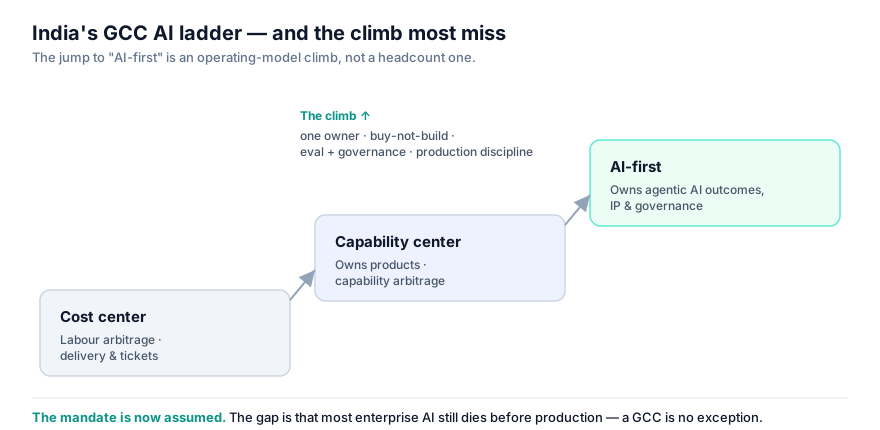
Moving up this ladder is an operating-model climb, not a headcount one. Each rung sells something different.
| Rung | What it sells | What it owns | The muscle it needs |
|---|---|---|---|
| Cost center | Labour arbitrage | Tickets and delivery to a scope | Throughput, SLA discipline |
| Capability center | Capability arbitrage | Products and roadmaps | Product ownership, engineering depth |
| AI-first center | Outcome arbitrage | Agentic outcomes, IP, governance | Buy-not-build, eval, production discipline |
You don't climb a rung by adding people to the rung below. A bigger delivery team just makes a better cost center. It doesn't make a capability center. The jump is a change in what you're accountable for, and most "AI transformation" plans quietly budget for more headcount instead of the harder change in mandate.
Build, partner, or boost: the decision that separates the two outcomes
The single most expensive mistake I see in GCC agentic programs is building the whole stack from scratch, often to justify headcount. In 2026, orchestration frameworks, evaluation harnesses, and voice pipelines are commodity. Rebuilding them burns the budget on plumbing and leaves nothing for the part that's yours.
The discipline is boring and decisive: buy the commodity 80%, build the differentiated 20%, boost what already works. The 20% worth owning is the slice encoded with your enterprise's proprietary process, data, and risk rules. It's the part a vendor structurally can't build for you. That's where a GCC's capability arbitrage is real: owning that differentiated slice at Indian cost, in production. I've laid out the full build-vs-partner-vs-BOT decision on the AI Capability Center pillar, and the general framework in build vs buy vs boost.
Agentic AI is not the last wave of automation
GCCs industrialized RPA and scripted bots, deterministic systems that did exactly what they were told. It's tempting to run the same playbook on agents. That's a trap.
An agent's defining feature is autonomy: it can be confidently, fluently wrong and act on it. The governance that was optional for a scripted bot is load-bearing for an agent: guardrails, an audit trail, evaluation that runs continuously, and a stop button. GCCs that treat agents as "RPA that talks" ship demos no compliance team will let near a real customer. (For high-stakes domains the reliability problem is architectural, not a prompt you tune. I cover that in deterministic AI agents.)
What the GCCs that climb actually do
Line up the centers that reach AI-first against the ones stuck scaling pilots, and the difference isn't the tech budget. It's five deliberate choices:
- One accountable owner for each agentic outcome, with the mandate and budget to reach production. Not a pilot scattered across delivery pods.
- Buy-not-build discipline. Commodity bought, the differentiated 20% owned, budget spent where the moat is.
- Eval from day one. A defined evaluation and an ROI baseline set before launch, then measured continuously.
- Governance built into the architecture rather than bolted on: guardrails, audit trail, a stop button.
- A production mandate instead of a delivery SLA. The center is accountable for the business outcome, which is what the climb actually means.
None of it is exotic. It's the operating model of a company that ships AI, installed inside an org whose default muscle is to deliver a scope. Closing that gap is the hard part.
Where the window is
The mandate era is the easy part, and it's here. The centers that convert it won't be the ones that hire the most AI engineers or run the most pilots. They'll be the ones that make the operating-model climb on purpose: owning outcomes instead of SLAs, buying the commodity, building the governance muscle a delivery org was never asked to have. India's GCCs are the best-positioned AI-delivery machines on earth. Whether they become AI-capability machines is an operating-model choice, and the window to make it is open now.
Related: Building an AI Capability Center in India · Why 95% of enterprise AI pilots die · Build vs Buy vs Boost enterprise AI.
Vikas Goel is the founder of Thinkerwave AITech and a former enterprise CTO. Over 30 years he has built production AI and enterprise-grade systems from India, including a carrier-scale recommendation engine driving upsell revenue across hundreds of millions of subscribers, and enterprise voice AI used by millions. He works with enterprises and their India GCCs as a fractional AI CTO and AI advisor.
- GCC
- Agentic AI
- India AI
- Enterprise AI
- AI Strategy