Why 95% of Enterprise AI Pilots Die: the Operating Model of the 5% That Ship
95% of enterprise AI pilots show no measurable P&L impact, and it's almost never the model's fault. A pilot and a production system are different disciplines. This piece covers why pilots die in the gap between them, and the specific operating model the surviving 5% share: one owner, buy-not-build, eval discipline, a production harness, and ROI baselining.
By Vikas Goel
The number everyone quotes in 2026 is that 95% of enterprise AI pilots show no measurable P&L impact. People read that as proof AI is overhyped. It points to something else.
Because when you look at why those pilots die, it's almost never the model. The technology worked in the demo. What killed the pilot was everything around the model, the part nobody built, because a pilot and a production system are different disciplines and most teams only ever practiced the first one.
I've spent 30 years taking systems from "it works in the demo" to "it runs in front of millions of real users." That gap is where 95% of AI dies. Below is the map of it, and what the 5% who make the crossing do.
Why pilots die
A pilot is designed to prove a model can do something impressive, once, in friendly conditions. That's a low bar, and modern models clear it easily. That ease is the trap. Clearing it feels like success and tells you almost nothing about whether the thing will survive contact with production.
The pilots that die share the same causes, and none of them is "the model wasn't good enough":
- No owner. The pilot was a team's side project. Nobody had the mandate or budget to take it the rest of the way, so it stalled the moment the demo applause faded.
- No path to production. It was built in a sandbox, disconnected from the real systems, data, and workflows it would need to live inside.
- Evaluation and ROI were never defined. Nobody decided up front what "working" meant or what business number it had to move, so there was no way to prove it worked and no case to fund the next step.
- Everything was built from scratch. The team spent the budget rebuilding commodity plumbing instead of the part that mattered. (More on that in build vs buy vs boost.)
- No governance. No guardrails, no audit trail, no way to stop it if it misbehaved, so it could never be trusted with anything real.
MIT's researchers put it bluntly: pilots fail because organizations avoid the friction that production requires, the unglamorous integration, evaluation, and governance work.
A pilot and a production system are different disciplines
This is the reframe that matters. The skills that win a pilot (a sharp prompt, a compelling demo, a model that dazzles once) are nearly unrelated to the discipline that keeps a system alive in production: reliability at cost, integration, evaluation, monitoring, governance, and a measurable outcome.
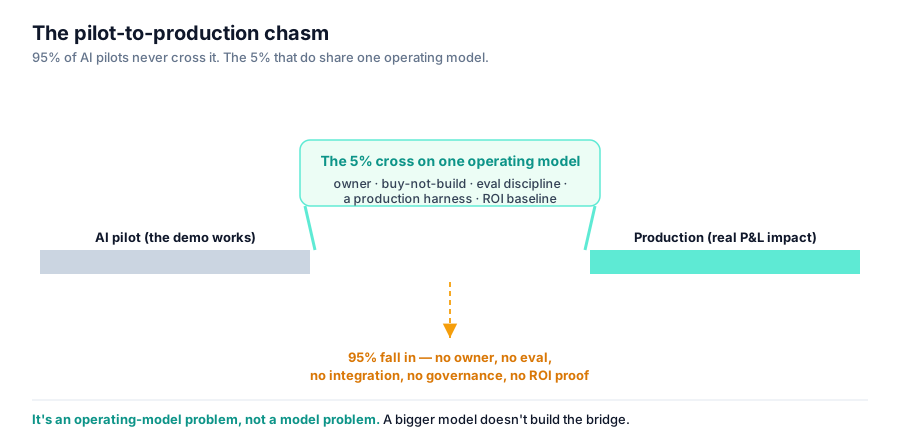
A bigger model doesn't build that bridge. It makes a better demo, which gets you deeper into the chasm with more confidence. This is an operating-model problem, not a model problem, and you don't solve an operating-model problem by upgrading the model.
What the 5% do differently
The pilots that reach production aren't running better models. They're run differently. Line them up against the ones that die and the pattern is stark.
| Dimension | The pilot that dies | The pilot that ships |
|---|---|---|
| Ownership | A team side-project, no owner | One accountable owner with budget |
| Build vs buy | Builds everything from scratch | Buys the 80%, builds the critical 20% |
| Evaluation | "Looks good" | A defined eval, measured from day one |
| Integration | Sandbox demo | Wired into real workflows and data |
| Governance | None | Guardrails, audit trail, a stop button |
| ROI | Measured after (if ever) | Baselined before, with a holdout |
None of these is exotic. They're the boring, deliberate work of treating production-readiness as a design requirement from the first day, not a phase you hope to bolt on after the demo earns applause.
It starts with one owner
If you change only one thing, change this: give AI a single accountable owner with the mandate and budget to cross the chasm. Scattered pilots across teams with nobody owning the outcome is the single most common shape of the 95%.
For large enterprises that's a Chief AI Officer. For mid-market companies with stalled pilots and no one owning AI, it's increasingly a fractional AI leader, someone who has crossed the chasm before and can install the operating model without a full-time executive hire. The title matters less than the fact that someone owns the outcome, not just the experiment.
The checklist to cross the chasm
Before you start your next AI pilot, decide these up front, not after:
- Who owns this to production? Name them. Give them budget.
- What business number must it move, and what's the baseline? Define it before launch.
- What do we buy vs build? Buy the commodity, build only the differentiated 20%.
- How does it integrate with the real systems and data it'll depend on?
- What's the eval that tells us it's working, measured continuously?
- What's the governance harness? Guardrails, audit trail, the stop button.
If you can't answer these, you're running a demo, not a pilot. That's what the 95% were.
The part nobody wants to do
AI isn't failing enterprises. Enterprises are running pilots and expecting production, and those are different disciplines. The 5% that ship didn't find a better model. They owned the outcome, bought the commodity, measured from day one, and built the unglamorous bridge across the chasm on purpose. None of that came from better technology. It came from how they ran the work, and any team willing to do the boring part can copy it.
Related: Deterministic AI Agents: the complete guide · Build vs Buy vs Boost enterprise AI · Deterministic AI agents: beating hallucination.
Vikas Goel is the founder of Thinkerwave AITech and a former enterprise CTO. Over 30 years he has built enterprise-grade systems and shipped enterprise voice AI used by millions, taking AI from demo to production. He works with founders and enterprises as a fractional AI CTO and AI advisor.
- Enterprise AI
- AI Pilots
- Production AI
- Agentic AI
- AI Strategy
- CTO