Deterministic AI Agents: How to Beat Hallucination on the Problems That Actually Matter
Ordinary AI is confident, which is fine until the problem is hard, contested, and expensive to get wrong. Then confidence without the ability to doubt itself becomes the danger. This is why autonomous agents hallucinate on high-stakes problems, why a bigger model makes it worse, and what the deterministic gatekeeper architecture does to make an agent trustworthy: grounding, tool-input validation, structured-output enforcement, and confidence-gated escalation.
By Vikas Goel
Ordinary AI is confident. Ask it almost anything and it answers, fluently, right away. For most tasks that's what you want.
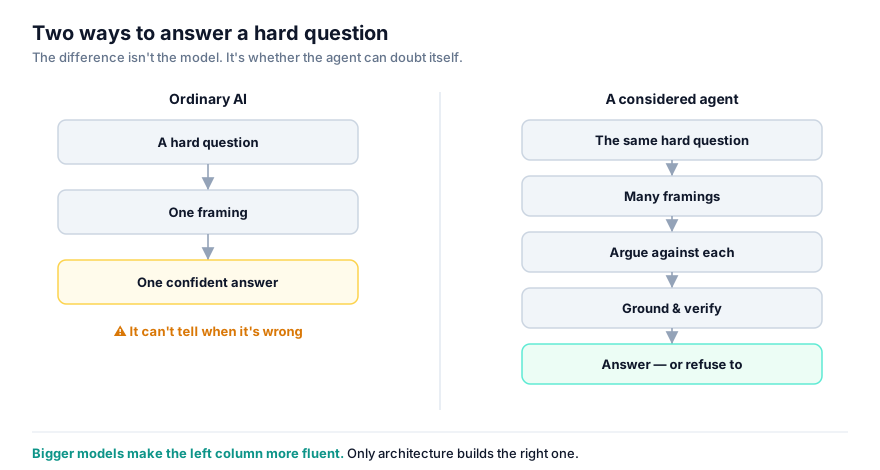
Then you point it at a hard problem, the kind where the framing itself is unclear, the experts disagree, and being wrong is expensive. Now the same confidence becomes the danger. The agent commits to one reading of the problem and produces an answer that sounds as sure as a correct one. It can't tell you it might be wrong, because it never considered that it might be.
I've spent 30 years building enterprise-grade systems, including voice AI used by millions, and this is the failure mode that separates a demo from something you can put in front of a credit committee, a security team, or a research pipeline. It's an architecture problem, not the model, and it's fixable.
Why AI agents hallucinate on hard problems
A hallucination isn't a malfunction. The model is doing what it was trained to do: produce a fluent, plausible answer. It got rewarded, over and over, for sounding right, and never for noticing when it wasn't.
On an easy problem, the single most obvious framing is usually the correct one, so this works fine. On a hard problem, the framing is everything, and the agent picks one silently and optimizes within it. Nothing in an ordinary agent makes it stop and ask whether that's even the right way to look at the problem. So it answers the wrong question, confidently, and hands you a result you can't tell apart from a right one.
"Deterministic" doesn't mean identical output
When people say they want a deterministic AI agent, they almost never mean "the same tokens on every run." They mean trustworthy: it won't confidently invent, it behaves predictably against known rules, it's honest about what it doesn't know, and you can audit why it did what it did.
That's the definition worth chasing. The determinism that matters is bounded, grounded, explainable behavior, not bitwise reproducibility. You don't get there by turning down a temperature setting. You get there by changing the shape of the system.
The four behaviors of a trustworthy agent
An agent you can trust on a hard problem does four things an ordinary one doesn't. That's the design principle behind our product ThinkerWave, which we built for the problems where being wrong is expensive.
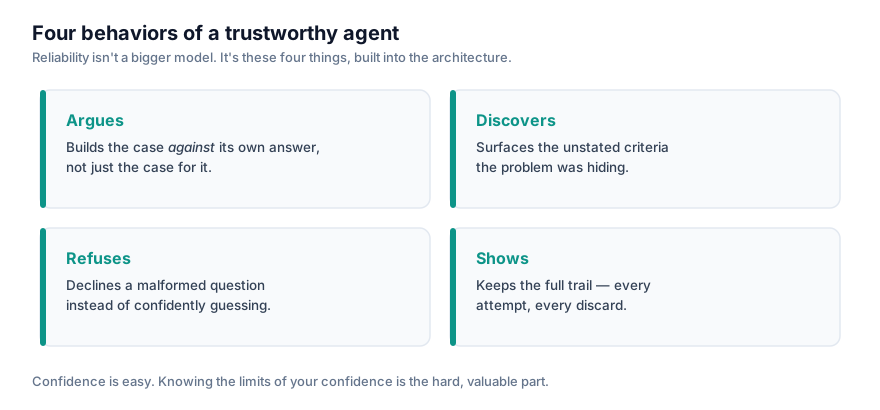
- It argues against its own answer. The most dangerous agent only builds the case for its conclusion. A trustworthy one also builds the case against it and checks whether the answer survives. An answer it can't argue itself out of is a useful signal, though still well short of proof.
- It hunts for the criteria nobody stated. Hard problems carry hidden constraints nobody wrote down: the regulation that applies, the edge case that bites, an assumption everyone made without saying so. A good agent surfaces those while it works instead of quietly stepping over them.
- It refuses malformed questions. Declining to answer is often the right call. "I can't answer this safely without X" beats a confident guess, because the guess is what gets you breached or sued.
- It shows its work. Every attempt it made, every path it discarded, and where each fact came from. Not for neatness. On a high-stakes call, an answer you can't audit is an answer you can't use.
The deterministic gatekeeper architecture
Those four behaviors are the goal, not something you get by asking the model nicely. A prompt that says "be careful" is a wish, and a wish doesn't gate anything. They come from a specific architecture that's worth naming, because it's the piece most teams are missing.
The pattern is a deterministic gatekeeper: an enforcement layer that sits in the execution path, between the reasoning model and any consequential action. The model still does what it's brilliant at, which is reasoning, planning, and language. It just no longer gets to act unchecked. Every proposed answer or tool call has to pass four gates before it becomes real:
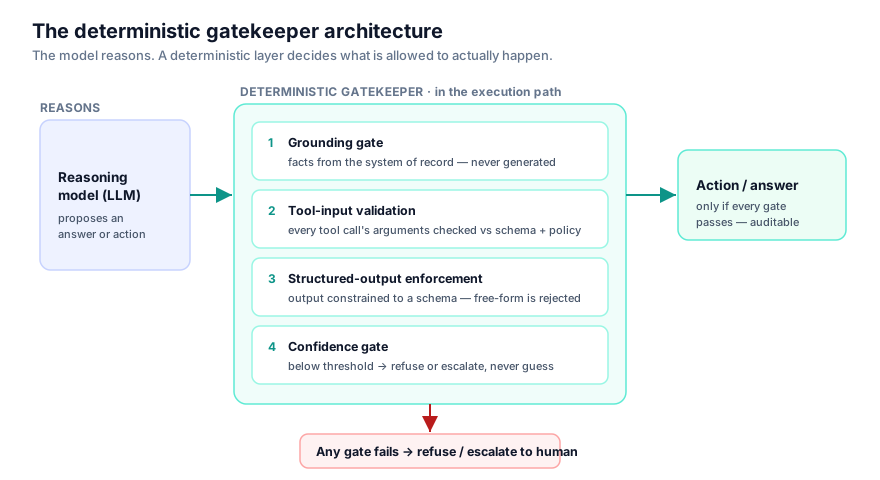
- Grounding gate. Any fact the agent asserts must come from a system of record, not from generation. If it can't be sourced, it can't be stated.
- Tool-input validation. Every tool call's arguments get validated against a schema and policy before execution. A malformed or out-of-bounds call never runs.
- Structured-output enforcement. The model's output is constrained to a schema. Free-form text where a structured decision is required gets rejected, not parsed and hoped over.
- Confidence-gated escalation. Anything below a confidence or verification threshold is refused or handed to a human instead of executed on a guess.
The critical word is deterministic: these gates are code, not model behavior. They do the same thing every run regardless of how the model is feeling. That keeps the agent's behavior bounded and predictable even though the model at its core is probabilistic. The determinism lives in the enforcement layer, not in the reasoning.
So when should an agent be deterministic? The rule is simple: make it deterministic when the cost of a confident wrong action exceeds the cost of a slower or refused one. For drafting a marketing email, skip all of this and let the model run. For moving money, changing a medical record, or telling a customer their coverage, the gatekeeper stops being optional. It's what stands between a demo and something you can put in production.
Why a bigger model makes it worse
The reflex is to reach for a more capable model. That's the wrong reflex, and it's worth knowing why: a smarter model doesn't hallucinate less, it hallucinates more fluently. It makes the wrong answer more persuasive and harder to catch. You've raised the quality of the prose without touching the thing that produced the error.
This matches where the field landed in 2026. The safest systems on high-stakes problems are rarely the highest-capability ones. They're the ones where capability is reconciled with enforcement: facts pulled from deterministic sources instead of generated, decisions constrained by explicit rules, escalation to a human the moment confidence drops. Capability is the engine. Trust comes from the architecture around it.
Where this matters
Not every problem needs this. Most don't, and for the simple ones a fast, confident answer is fine. The machinery of arguing against your own conclusion and grounding every claim only earns its cost on a specific kind of problem.
| Easy problem | Hard, high-stakes problem | |
|---|---|---|
| The framing | Obvious, single | Contested, multiple valid ones |
| Cost of being wrong | Low, fix it later | High: credit loss, breach, recall, bad policy |
| What "good" requires | A fast, fluent answer | Grounding, a counter-case, and honest uncertainty |
| Right move when unsure | Answer anyway | Refuse or escalate |
The domains where this is most of the work are the obvious ones: credit and portfolio risk, cybersecurity threat assessment, drug discovery, energy forecasting, policy evaluation, manufacturing diagnostics. Anywhere the answer isn't obvious, the experts disagree, and someone pays a real price for a confident mistake.
The build checklist
If you're building an autonomous agent you intend to trust:
- Ground every fact in a real source. Pull it from a system of record instead of generating it.
- Generate the counter-case. Make the agent argue against its own conclusion before it commits.
- Constrain with explicit rules, not just prompts. The enforcement has to sit in the execution path itself.
- Set a refusal threshold. A confidence floor, below which the agent clarifies or escalates rather than answering.
- Keep the full audit trail. Attempts, discards, sources, so any decision can be reconstructed later.
- Reconcile capability with enforcement. Use the strong model to reason, but never let it be the thing that acts unchecked.
What gets an agent trusted
The agents that get trusted with the problems that matter won't be the ones running the biggest model. They'll be the ones that know the limits of their own confidence: they argue against themselves, surface what nobody told them, refuse what they can't answer, and show every step of how they got there.
If you're putting an agent anywhere near money, health, or security, that's the bar. Build the gatekeeper before you build anything else.
Related: Deterministic AI Agents: the complete guide · Voice Model Optimization — making voice agents fast and grounded.
Vikas Goel is the founder of Thinkerwave AITech and a former enterprise CTO. Over 30 years he has built enterprise-grade systems and shipped enterprise voice AI used by millions, and he now builds autonomous, self-evolving AI for complex non-linear problems. He works with founders and teams as a fractional AI CTO and AI advisor.
- Deterministic AI Agents
- AI Agent Architecture
- AI Hallucination
- Autonomous Agents
- Trustworthy AI
- Agentic AI