AI Capability Centers · India GCC
Build vs Partner: Setting Up an AI Capability Center (GCC) in India
India is where most global enterprises now build their AI capability. The first decision isn't where, it's how: build your own center, partner, or Build-Operate-Transfer. This page lays out the decision framework, from a founder and former CTO who built AI teams, products, and P&L in India at enterprise scale.
What is an AI capability center (GCC)?
An AI capability center is a Global Capability Center (GCC): your own team, usually in India, that owns AI and engineering work instead of outsourcing it. The defining shift of 2026 is that GCCs have stopped being cost centers doing back-office delivery and become capability centers that own products, IP, and AI outcomes for the parent enterprise. India now hosts over 2,000 GCCs. More than 1,200 already run AI/ML capabilities.
Build your own, partner, or BOT?
Before anything about India, settle the ownership question. Is AI capability a durable, core advantage you must own long-term? Everything follows from the answer.
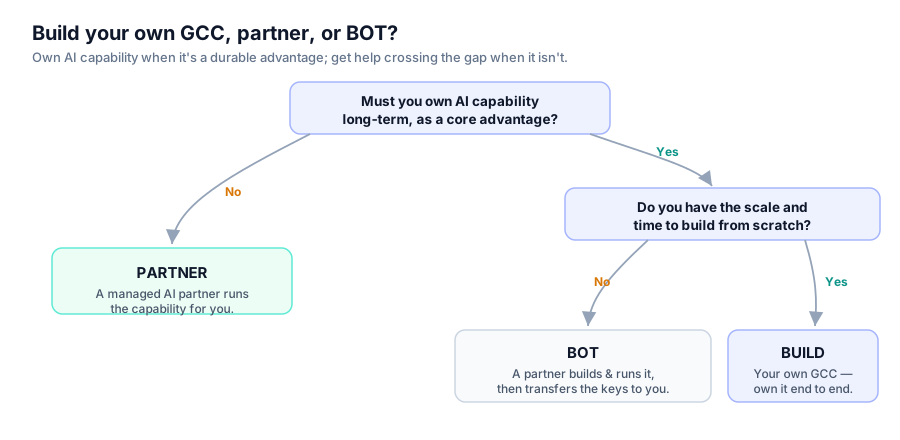
- If no, because it's capability every competitor will have, partner. A managed AI partner runs it, and you get speed without the overhead.
- If yes, the next question is capacity: do you have the scale and the time to build a center from scratch?
- If no, use BOT (Build-Operate-Transfer). A partner builds and runs the center, then transfers ownership to you on an agreed timeline. You get ownership in the end, with help crossing the gap now.
- If yes, build your own GCC and own the capability end to end.
The three models, compared
| Partner | BOT | Build your own GCC | |
|---|---|---|---|
| Time to capability | Weeks | Months | A year+ |
| Ownership | Vendor's | Transfers to you | Fully yours |
| Upfront effort | Low | Medium | High |
| Capability you keep | Little | All of it, eventually | All of it |
| Best for | Non-core capability, fast | Own it eventually, start now | Core advantage, at scale |
Why India
India hosts the largest concentration of AI and engineering talent inside GCCs anywhere in the world, at 40–70% lower cost than a comparable US build. But cost is no longer the headline. The 2026 shift is to capability arbitrage: India GCCs increasingly co-own products, IP, and business outcomes rather than just executing tasks. For a US enterprise, that means your India center can be where the AI advantage is built, rather than only where it's delivered cheaply.
The trap: a cost center wearing an AI label
The most common failure has nothing to do with picking the wrong model. It's standing up a center and running it like a cost center: measured on headcount and tickets, with no ownership of outcomes. It produces activity without capability. A real AI capability center owns products and outcomes, has a single accountable AI leader, and is judged on what it ships to production and what that moves in the business.
Cross the pilot-to-production gap inside the GCC
Wherever the team sits, the same discipline decides whether AI reaches production. Most enterprise AI pilots die in the gap between demo and production (the 95% problem), and a GCC is no exception. Buy the commodity 80% of the stack and build the differentiated 20% (build vs buy vs boost), install real evaluation and governance, and give the center a mandate to own outcomes. Capability comes from ownership plus production discipline, and never from headcount alone.
Frequently asked questions
What is an AI capability center (GCC)?
An AI capability center is a Global Capability Center (GCC): a company's own team, usually in India, that owns AI and engineering work rather than outsourcing it. The 2026 shift is that GCCs are moving from cost centers doing back-office delivery to capability centers that own products, IP, and AI outcomes for the parent enterprise.
Should you build your own GCC or partner for AI capability?
Build your own GCC when AI capability is a durable, core competitive advantage and you have the scale and time to stand up a center. Partner when it isn't your differentiator and you want speed. Use Build-Operate-Transfer (BOT), where a partner builds and runs the center then transfers it to you, when you want to own it eventually but need help crossing the setup gap now.
What is Build-Operate-Transfer (BOT) for a GCC?
Build-Operate-Transfer is a middle path: a partner sets up your India capability center, hires and runs the team, and operates it to a working state, then transfers ownership to you on an agreed timeline. It gets you a functioning AI capability in months instead of the year-plus a from-scratch build takes, while still ending in full ownership.
Why build AI capability in India?
India hosts the world's largest concentration of AI and engineering talent inside GCCs. Over 1,200 India GCCs already run AI/ML capabilities, backed by hundreds of thousands of AI professionals, at 40–70% lower cost than a US build. The 2026 narrative has shifted from cost arbitrage to capability arbitrage: India GCCs increasingly co-own products and outcomes rather than just delivering tasks.
How do you turn a GCC from a cost center into an AI capability center?
Give it a real mandate and ownership. Let it own products and outcomes instead of tickets, put a single accountable AI owner in place, buy the commodity 80% of the AI stack and build the differentiated 20% in-house, and install the pilot-to-production discipline (evaluation, governance, integration) that most AI pilots die without. Capability comes from ownership plus production discipline, not headcount.
Deciding how to build AI capability in India? Get in touch. I advise US enterprises and their India GCCs on exactly this, as a fractional AI CTO and advisor.
Related: Why 95% of AI pilots die · Build vs Buy vs Boost · Fractional AI CTO · About Vikas Goel