Voice Model Optimization: Why Your Voice AI Sales Agent Sounds Slow, and How to Fix It
A voice AI sales or lead-qualification agent fails in two ways: it's too slow, or it's confidently wrong. Both are voice model optimization problems. This is the production playbook: the latency budget, the levers that move it, and how to make the agent fast and grounded enough to trust on a live call.
By Vikas Goel
A voice AI sales agent has one job that most teams underestimate: to sound like a competent human on a live call. It fails in two ways. It's too slow, so the pauses give it away and the caller loses patience. Or it's confidently wrong: it quotes a price that doesn't exist, promises a feature you don't have, or marks a tyre-kicker as a hot lead.
Both are voice model optimization problems, and both are solvable. Just not by reaching for a bigger model, which is the first thing everyone tries and the last thing that works.
I've spent years running enterprise voice AI used by millions of people. Below is the playbook I use: the latency budget, the levers that move it, and the reliability half most guides skip.
Why voice is the hardest place to run an AI agent
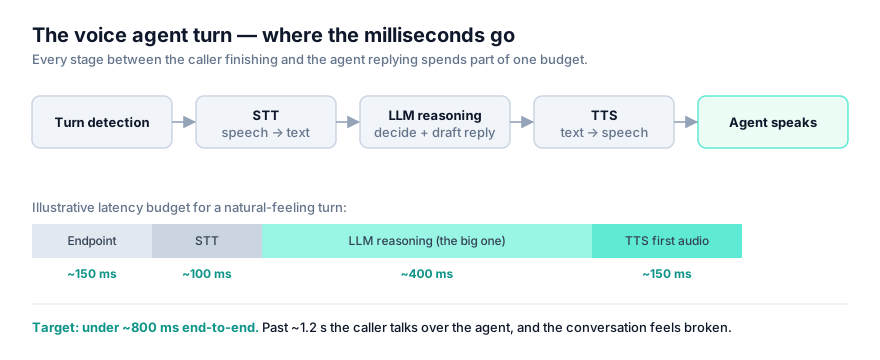
A chat agent can take three seconds to answer and nobody minds. A voice agent cannot. Human conversation runs on a rhythm: the gap between one person finishing and the next starting is around 200 milliseconds. Stretch that to a second and the call feels wrong. Stretch it to two and the caller starts talking over your agent.
So a voice agent is running a race the text world never has to run. Every stage between the caller finishing their sentence and the agent beginning its reply is spending part of one small budget.
What is voice model optimization?
Voice model optimization is the practice of tuning the three models behind a voice agent (speech-to-text, the language model, and text-to-speech) along with the turn-taking around them, so the agent responds fast enough to feel human and reliably enough to trust. It's a pipeline of several stages, and it's only as good as its slowest, least reliable one.
The three stages:
- STT (speech → text) turns the caller's audio into text the model can read.
- The LLM decides what to do and drafts the reply. This is usually the biggest slice of the budget.
- TTS (text → speech) turns the reply back into natural audio.
Wrapped around all three is turn detection: knowing when the caller has finished, not merely paused for breath. Get that wrong and the agent interrupts people, which is worse than being slow.
The latency levers that matter
You don't buy speed with one trick. You buy it by shaving every stage and, above all, by overlapping them instead of running them one after another.
| Lever | What it buys you | The trade-off |
|---|---|---|
| Streaming STT | Transcribe as the caller speaks, not after, so the text is ready the instant they stop | Slightly higher error rate on partial words |
| Model routing | Send easy turns to a small fast model, hard turns to a big one | You have to define "hard" well |
| Streaming TTS | Start speaking the first sentence while the rest is still generating | Needs careful sentence chunking |
| Quantization + distillation | Smaller models that run faster and cheaper at the same quality | Some accuracy loss; needs eval to prove it's safe |
| Turn-detection tuning | Fewer interruptions and less dead air | Over-tuning makes the agent slow to jump in |
| Prompt compression + KV-cache reuse | Less to process on every single turn | Engineering effort to maintain |
| Warm, colocated models | No cold-start penalty, no network hop between stages | Infrastructure cost |
The single biggest win is almost always routing plus streaming. Most turns in a real call are simple (a greeting, a confirmation, a "yes, that's right") and don't need your most expensive model or a full round-trip. Reserve the heavy reasoning for the turns that need it, and start speaking before you've finished thinking.
The other half nobody optimizes: reliability
The trap is this. You can win the latency race and still lose, because a fast agent that lies is worse than a slow one. On a sales or lead-qualification call, a hallucination isn't a typo you can fix later. The caller heard a wrong price, a promise is now on the record, a "lead" got logged that was never real.
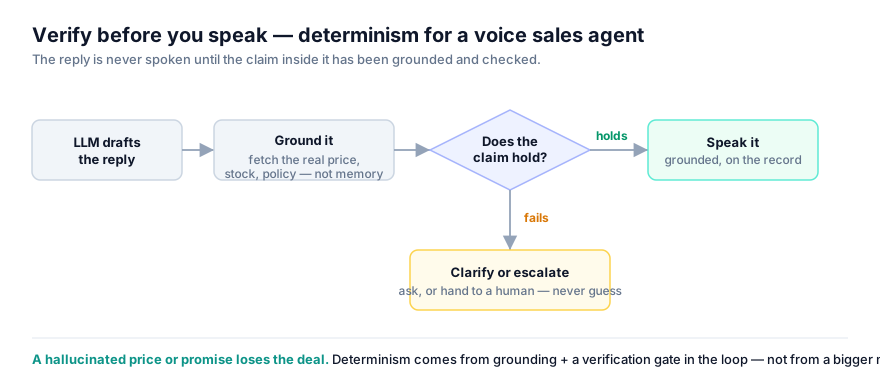
This is where speed and trust pull against each other, and where most voice deployments quietly fail. A bigger model won't save you here. Bigger models hallucinate too, only more fluently. The fix is architectural: ground the claim, then verify it, before you ever speak it.
Concretely, that means:
- Ground every fact. Prices, availability, and policies come from a live source (your CRM, catalogue, or pricing table), never from the model's memory.
- Generate structure, not prose, for anything that matters. Facts and qualification fields come out as tool calls the system can check, not free text the model can improvise.
- Put a verification gate in the loop. The drafted reply is checked against the grounded facts before it's spoken. If it doesn't hold, it doesn't go out.
- Let the agent refuse. Give it permission to clarify or hand off to a human when it isn't sure. "Let me confirm that and call you right back" beats a confident wrong answer every time.
This is the same principle our product ThinkerWave is built on: an AI that argues against its own answer, refuses malformed questions instead of guessing, and shows its work. Here it's applied to the unforgiving setting of a live phone call.
Lead qualification, specifically
A lead-qualification voice agent has to do two hard things at once: keep the conversation natural (the latency problem) and extract structured truth (the reliability problem). Those pull in opposite directions, which is why it's hard.
The pattern that works:
- Extract, don't chat, on the fields that matter. Need, budget, timing, and fit come out as structured fields via tool calls, so "qualified" means something you can trust, not a vibe the model formed.
- Ground each field against real data as the call happens.
- Confirm back in natural language. "Just so I've got it right, you're looking to move on this within the quarter?" That reassures the caller and catches errors before they're logged.
- Escalate on low confidence rather than forcing a score.
This is the layer that turns raw prospecting into pipeline. Torbi finds the buyers already showing intent (customs records, RFQs, hiring spikes), and a grounded voice agent then qualifies them on a real call without inventing anything. Signal finds them, a reliable voice agent confirms them.
The practical checklist
If you're shipping a voice agent, this is the order that matters:
- Measure your budget. Instrument every stage. You can't optimize latency you can't see.
- Stream everything (STT in, TTS out) and overlap stages instead of chaining them.
- Route models so easy turns are cheap and fast and only hard turns are expensive.
- Ground every factual claim against a live source.
- Add a verification gate between the draft and the spoken reply.
- Set a refusal threshold: a point below which the agent clarifies or escalates.
- Log every turn (transcript, grounded facts, the decision) so failures are debuggable, not mysterious.
What the winning voice agent looks like
The voice agent that wins isn't the one running the biggest model. It's the one tuned to be fast and grounded: quick enough to feel human, disciplined enough never to say something it can't back up. That's a voice model optimization problem end to end, and it's an architecture decision more than a model choice.
Vikas Goel is the founder of Thinkerwave AITech and a former enterprise CTO. Over 30 years he has built enterprise-grade systems and shipped enterprise voice AI used by millions. He works with founders and teams as a fractional AI CTO and AI advisor on these production voice and agent problems.
- Voice AI
- Voice Model Optimization
- AI Agents
- Lead Qualification
- Conversational AI
- Production AI