Build vs Buy vs Boost Enterprise AI: A CTO's Decision Framework
Should you build your own AI agents or buy a platform? The honest 2026 answer is neither on its own. Most enterprises should buy the 80% and build only the critical 20%. This is the decision framework, the real total cost of each path, and why ~75% of in-house AI builds fail, from a CTO who's made the call with real budgets.
By Vikas Goel
"Should we build our own AI agents, or buy a platform?" is the most common question I get as a CTO and advisor, and it's almost always framed wrong. It's not a binary. Framed as build-or-buy, you either overspend rebuilding a commodity or hand your differentiator to a vendor's black box.
The honest 2026 answer is a third option, and it's what most enterprises should default to: buy the 80%, build the critical 20%. Below is the framework I use, the real cost of each path, and why roughly three-quarters of pure in-house builds underdeliver.
The three options, defined
- Buy. Adopt a vendor platform for a capability that isn't your differentiator. You trade control for speed and someone else's maintenance burden.
- Build. Develop it in-house because it's core to your edge and you have the team and data to do it well. You trade speed and cost for control and IP.
- Boost. The middle path: buy the commodity 80% of the stack and build only the 20% that is genuinely yours, usually with a partner. You keep the differentiator and skip rebuilding plumbing.
Most 2026 enterprise AI should be boost. The market has already moved this way: most AI use cases are now bought rather than built from scratch, and hybrid operating models have become standard.
The decision starts with one question
Before cost, before vendors, ask one thing: is this AI a core, durable differentiator for us? Everything flows from the answer.
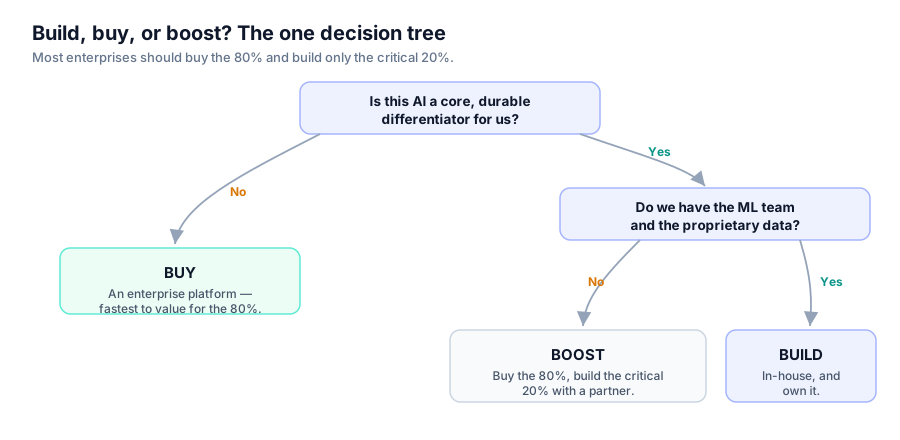
- If no (it's a capability every competitor will have), buy it. Speed to value wins, and there's no prize for a hand-rolled version of a commodity.
- If yes, ask the second question: do we have the ML team and the proprietary data to build it well?
- If no, boost. Buy the 80%, build the differentiated 20% with a partner who brings the team you don't have.
- If yes, build and own it.
The trap is answering "yes, it's a differentiator" out of ambition and then discovering you have neither the team nor the data, so you build slowly and expensively and it never quite works.
The real cost of each path
Build looks cheaper than it is, because the sticker price is a fraction of the lifetime cost. The maintenance tax never stops: evaluation, monitoring, retraining, security, keeping up with model releases.
| Buy | Build | Boost | |
|---|---|---|---|
| Time to value | Fastest (weeks) | Slowest (quarters) | Fast (weeks–months) |
| Upfront cost | Low–medium | High | Medium |
| Ongoing cost | Subscription | The maintenance tax, forever | Split; you carry only the 20% |
| Talent needed | Minimal | A full ML/MLOps team | A focused team + a partner |
| Control / IP | Low | Full | You own the part that matters |
| Biggest risk | Vendor lock-in | It underdelivers and never ships | Managing the seam between the two |
Why most self-builds fail
Around three-quarters of in-house enterprise AI builds underdeliver, and the reason is almost always the same: the model was never the moat. Teams set out to build a differentiator and spend eleven of twelve months rebuilding commodity infrastructure (retrieval, orchestration, monitoring, guardrails) that a vendor already ships and hardens. The scarce ML talent gets burned on plumbing. Then the maintenance tax arrives and never leaves.
Building from scratch makes sense in a small number of cases. For everything else, it's a slow, expensive way to arrive where a purchase would have put you in a fortnight.
The "boost" path in practice
Boost is where the discipline is. The rule: own the 20% that is yours, buy the rest.
What's almost always yours (build or tightly control): your proprietary data, your evaluation criteria, your orchestration logic, and the interfaces between components. That's your moat and your portability. It's what stops a vendor's black box from becoming your ceiling.
What's almost always theirs (buy): the foundation models, the speech stack, the vector infrastructure, the observability tooling. Rebuilding these earns you nothing.
Get the seam right and you get the best of both: vendor speed on the commodity, real ownership on the differentiator, and no capability debt, because you still build your own AI muscle instead of outsourcing your understanding.
The checklist
Run any enterprise AI decision through these:
- Is this a durable differentiator, honestly? If a competitor could buy the same thing tomorrow, it isn't.
- Do we have the ML team and the data? Not "could we hire someday." Do we have it now.
- What's the fully-loaded TCO of build, including the maintenance tax, not just the first version?
- What is the 20% that's ours, and can we own it while buying the rest?
- What's our exit if the vendor changes terms or falls behind? (Own your data and interfaces and you always have one.)
- Time-to-value: can the business afford the quarters that "build" costs?
What separates the winners
The enterprises that win with AI in 2026 didn't build the most or buy the most. They were honest about which 20% was really theirs, built that part well, and bought everything else. Build-or-buy was always the wrong question. Buy the 80%, build the 20%, and own the seam between them.
Related: Why 95% of enterprise AI pilots die · Deterministic AI agents: beating hallucination.
Vikas Goel is the founder of Thinkerwave AITech and a former enterprise CTO. Over 30 years he has built enterprise-grade systems and shipped enterprise voice AI used by millions, and has made these build-vs-buy calls with real budgets. He works with founders and enterprises as a fractional AI CTO and AI advisor.
- Enterprise AI
- Build vs Buy
- AI Strategy
- Agentic AI
- AI Agents
- CTO