Autonomous AI Agents · ThinkerWave
Autonomous AI Agents for Problems Without an Answer Key
An autonomous AI agent plans and carries out multi-step work with limited supervision. Vikas Goel builds ThinkerWave, an autonomous agent for hard problems where the experts disagree and a wrong call is expensive.
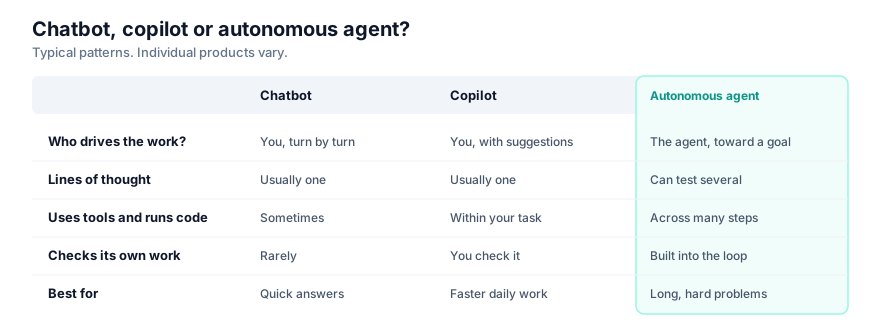
What makes an autonomous agent different
A chatbot answers. A copilot helps while you drive. An autonomous agent takes a goal, plans the steps, uses tools, looks at the results and changes course without you directing each turn. That's valuable on long work, and risky if nobody can see or check what it did.
Why the hard problems are different
Coding agents have a useful advantage: the tests pass or fail. There's no test suite for whether a credit policy is right or a market is worth entering. An agent working on those questions has to find out what good looks like and show how far its answer can be trusted.
How ThinkerWave approaches it
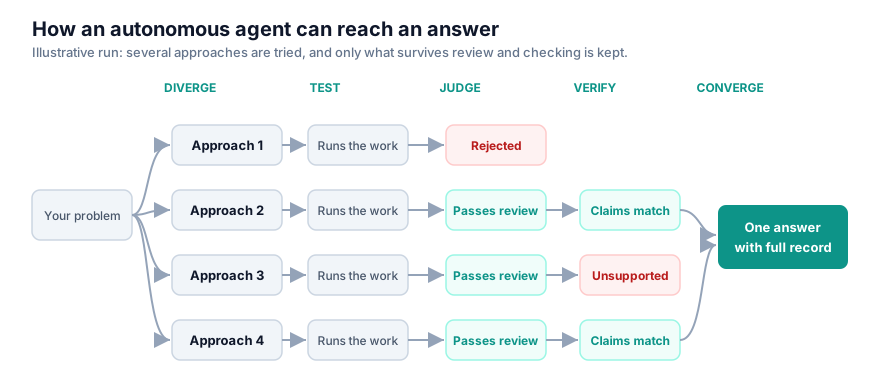
- Diverge: it starts several different approaches, and follows both paths when the evidence splits.
- Test: each attempt runs the numbers in code and checks real sources.
- Judge: a separate reviewer that didn't write the answer scores it.
- Verify: claims are matched to what was computed or found, and unsupported ones are flagged.
- Converge: the strongest parts merge into one recommendation, with the full record of how it got there.
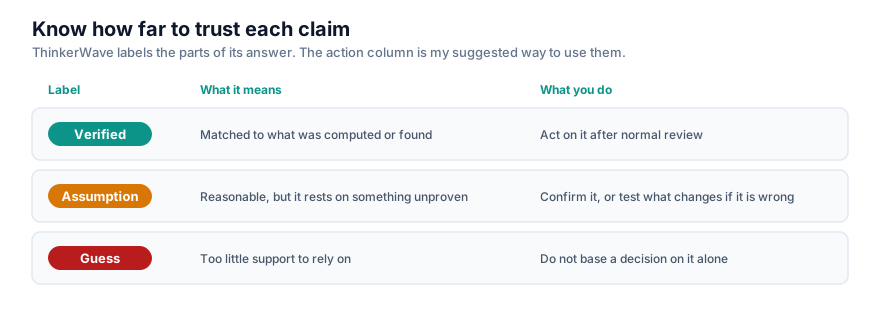
Each result separates what is verified, what rests on an assumption and what is a guess. The mechanism behind it is the subject of a pending Indian patent on self-evolving agent evaluation criteria.
How it helps you research
- It covers more ground. Several approaches make it less likely that one early framing decides the outcome.
- It does the work as well as the reading. It can run calculations in code and check sources, instead of only summarizing them.
- It shows its evidence. You can see what was tried, what was discarded and why.
- It finds gaps. Labels make it clear where the evidence runs out, which tells you what to investigate next.
How it helps you solve hard problems
| Your question | What the agent can work through |
|---|---|
| Should we buy more ambulances or fix hospital handovers? | Different framings of the delay, the numbers behind each, and what would change the answer |
| Which two of six drug candidates go forward? | The criteria that matter, the evidence for each candidate, and where the evidence is missing |
| Do we enter this market? | The case for and against, the assumptions underneath, and the risks that could change the call |
It supports your judgement and doesn't replace it. On a high-stakes decision, you still review the reasoning and make the call. For a quick lookup, a chatbot is cheaper and faster.
Try it or build with it
ThinkerWave runs in the browser and as a desktop app for Mac, Windows and Linux. Developers can use its Python SDK, command line and MCP server. See thinkerwave.com.
Making autonomous agents safe
- Deterministic AI agents: the complete guide
- AI agent security and blast radius
- The AI agent evaluation scorecard
- The research behind ThinkerWave
Building your own? I work with companies as a fractional AI CTO.
Frequently asked questions
What is an autonomous AI agent?
An autonomous AI agent plans and carries out multi-step work toward a goal with limited supervision, using tools and checking results along the way. How much autonomy is safe depends on the cost of a wrong action.
What is ThinkerWave?
ThinkerWave is an autonomous AI agent for hard, contested problems, built by Thinkerwave AITech, founded by Vikas Goel. It works a problem through several approaches and labels claims as verified, assumption or guess.
How is ThinkerWave different from a chatbot?
A chatbot usually follows one line of thought. ThinkerWave tests several, has them judged by a separate reviewer, checks claims against what was computed or found, and keeps the full record.
When should you not use an autonomous agent?
When a quick known answer is enough, or when an unchecked wrong action would be unacceptable. High-impact actions need limits and human approval outside the model.