AI Agent Evaluation: A 7-Metric Scorecard That Goes Beyond Accuracy
An agent can give the right final answer and still be unsafe, slow or ruinously expensive. Here is a seven-metric scorecard for AI agent evaluation, how to build a test set from real work, and how to set release gates before you ship.
By Vikas Goel
"It's 92% accurate" tells you very little about an agent.
An agent can reach the right answer after calling the wrong tool, spending ten times the budget, or skipping a step that a regulator cares about. A final-answer score would mark that run as a pass.
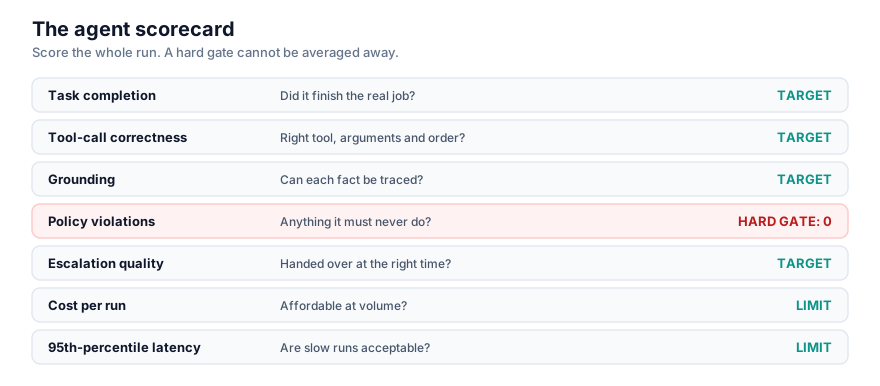
The scorecard
Score the whole run. These are the seven metrics I'd start with:
| Metric | The question it answers | Type |
|---|---|---|
| Task completion | Did it finish the real job? | Target |
| Tool-call correctness | Right tool, right arguments, right order? | Target |
| Grounding | Can each fact be traced to a source? | Target |
| Policy violations | Did it do anything it must never do? | Hard gate: zero |
| Escalation quality | Did it hand over when it should, and only then? | Target |
| Cost per run | Is it still affordable at volume? | Limit |
| 95th-percentile latency | Are the slow runs acceptable? | Limit |
The important column is the last one. A hard gate can't be traded away. Better completion doesn't excuse a policy violation, so don't merge everything into a single score that lets one hide the other.
Build the test set from real work
- Start with 30 to 50 real cases. Use anonymised production data, or real work from the team doing the job today.
- Include the difficult ones. Ambiguous requests, missing information, and cases where the right behaviour is to refuse.
- Write down what good looks like. Include expected tool calls and forbidden actions, as well as the answer.
- Add every production failure. A failure you turned into a test case can't quietly come back.
Run it like software testing
Agents are probabilistic, so a single pass proves little. Run each case several times and look at the pass rate and the spread.
Run the suite when the prompt, model, tools or retrieved data change. Model swaps deserve particular suspicion: a new version can improve your overall score and still break one workflow you depend on.
Use code to check what code can check, such as schemas, tool arguments, cost and forbidden actions. Keep model-based judges for the subjective parts, and test those judges against human labels, because a judge can be wrong too.
Set the release gate before you see the results
Decide your thresholds first. If you pick them after the run, you'll tend to approve whatever you got. A simple gate looks like this:
- Zero policy violations
- Task completion at or above the level of the current process
- Cost per run within budget (the AI agent cost calculator helps set this)
- No regression on any previously fixed failure
This is how you show an agent is ready for production rather than simply hoping. It's also the measurement side of deterministic AI agents.
Vikas Goel is the founder of Thinkerwave AITech and a former enterprise CTO. He works with enterprises and founders as a fractional AI CTO and AI advisor.
- AI Agent Evaluation
- AI Agents
- Production AI
- AI Agent Reliability
- LLM Evaluation